AI platform for thermal power plants · Kazakhstan
We reduce fuel consumption at thermal power plants with no upfront software costs.
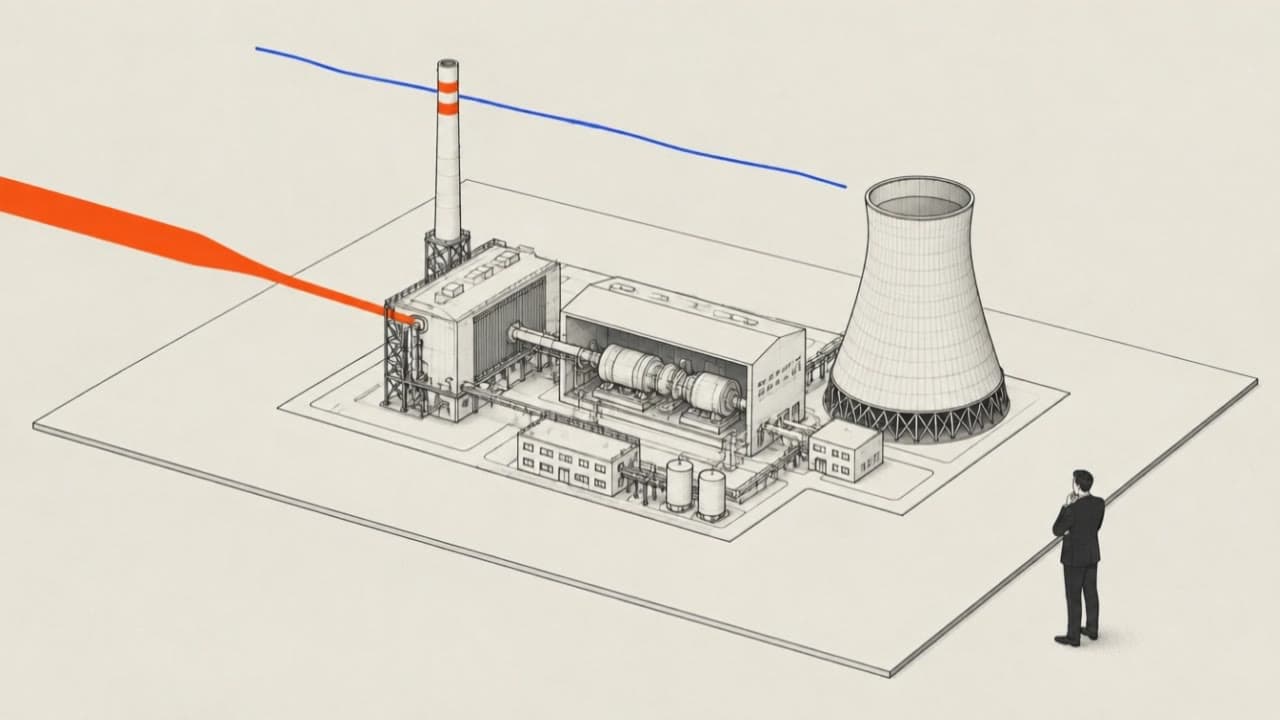
GSE Reason finds fuel-efficient operating modes for the plant and helps prove the effect. Inside a closed loop, without controlling equipment.
↓Into the plant
01Data
Data
Instrument readings, logs and plant constraints.
02Model
Model
Fuel consumption for every admissible mode.
03Recommendation
Recommendation
Personnel see the effect, decide and confirm the result.
Up to 6%
Fuel reduction potential
1.56%
Estimated potential in the pilot
0 CAPEX
For software
On-prem
Data stays at the plant
Platform
Six modules in one loop
01
Indicators
Plant and equipment performance metrics.
02
Energy balances
Resource reconciliation, imbalance detection.
03
Optimisation
Load distribution with lower fuel use.
04
Planning
Scenario comparison and mode plan.
05
Forecasting
Consumption and indicators from history.
06
Deviation control
Anomalies, causes, personnel response.
What each role gets
01 — Executive
A measurable economic effect, a transparent methodology for confirming it, and a project launch with no upfront burden on the investment budget.
AI agent
Not just a deviation alert — an explanation and the next step
The AI agent works on the plant's digital model and context: it shows the anomaly, possible causes, the consequences of inaction and options for checking. The user sees the source readings, asks clarifying questions and makes the decision independently.
Note
For deep adaptation, the agent is trained on the enterprise's available history. The recommended depth is 5–7 years; actual requirements depend on data quality and project objectives.
How savings are confirmed
First we agree on the calculation rules. Then we calculate the effect.
Before the commercial stage, GSE and the plant fix the methodology for assessing the economic effect, the calculation boundaries, data sources and adjustment factors. The comparison is made for a comparable production task, taking into account the equipment configuration and external conditions.
Normalisation factors
- Electricity and heat output
- Equipment configuration and availability
- Start-ups, shutdowns and transient modes
- Repairs and technical condition
- Fuel net calorific value, moisture and ash content
- Outdoor air and cooling water temperature
- Auxiliary consumption
- Dispatch and balancing constraints
- Data quality
Result
The calculated potential, the recommendations actually implemented and the confirmed economic effect are shown separately.
Energy service model
GSE takes on the investment in the system
GSE finances the agreed scope of implementation. Once savings are confirmed, part of the effect stays with the plant and part forms GSE's remuneration. If savings are not confirmed under the agreed methodology, no remuneration is calculated.
- No upfront licence purchase from the investment budget.
- The parties' interests align: GSE earns only when there is a measurable result.
- The plant receives part of the savings from the moment they are confirmed.
Important
Final terms, duration, cost structure and savings distribution are determined for each project individually.
Safe implementation
From retrospective calculation to commercial operation without risk for the customer
Stage 1
Preliminary analysis
We assess data availability, constraints and the potential reserve.
Stage 2
Retrospective modelling
We test the model on historical periods and agree on the methodology.
Joint approval
Stage 3
Personal advisor mode for operating personnel
The system issues recommendations, but personnel are not obliged to apply them; we compare the calculation with actual operation.
Joint approval
Stage 4
Controlled trial
Recommendations are applied only within agreed ranges and under the plant's responsibility.
Joint approval
Stage 5
Commercial operation
We scale confirmed scenarios and continuously monitor the effect.
Team

CBDO
Roman
Fedorov
Co-Founder & CEO
Adilkhan
Yessymkhanov
IT Advisor
Aizat
Kussainov
Strategic Advisor
Yerbol
Ashitov
Intellectual property
The GSE platform is protected by copyright
- Certificate
- No. 48427 of 17 July 2024
- Object
- Computer program “GSE Integrated Platform for Automating Business Processes of Planning and Accounting of Energy Resources at Heat Power Facilities”


Answers to questions
Excel is fine for individual calculations and reporting, but it links sources, the calculation formulas applied, constraints and operational comparison of many modes poorly. GSE Reason creates a single calculation loop, preserves data provenance and allows permissible scenarios to be recalculated in minutes.
Under the energy service model GSE finances the agreed scope of implementation. Remuneration is formed from the confirmed savings under a methodology agreed in advance. The terms are determined individually.
Because that would be inaccurate. The plant may have no upfront software costs, but the project involves contractual obligations and the distribution of the confirmed effect.
The completeness of measurements affects accuracy, and GSE does not hide this. At the first stage available measurements, technical standards, calculated relationships and agreed substitute indicators are used, with the confidence level and uncertainty indicated. The methodology fixes which conclusions are permissible at the current data quality.
Where there is no automatic signal, readings can be entered manually or recognised from a photo of a gauge, display, logbook or sheet using Computer Vision technology from GSE. The user confirms the result, and the system checks the range and saves the source.
GSE Reason can be deployed inside the enterprise's closed perimeter. The specific architecture, integrations and update procedure are agreed with the plant's IT and security services.
Full total output does not always mean equal efficiency of parallel units. The reserve may lie in the distribution of load between them. If equipment is at hard limits and there are no permissible options, the preliminary analysis will show this, and GSE will not promise an effect that does not exist. At the same time, transitional periods may still have an optimisation reserve.
The system takes the external production task and dispatch constraints into account. In the basic scenario it looks for minimum consumption at a given output. In balancing market scenarios the task may take into account the cost of changing output and equipment constraints; the decision remains with the operator.
Every recommendation must contain the initial assumptions and constraints. The user can reject it and state the reason. This is recorded and used in subsequent model tuning.
The project starts with retrospective modelling and an offline mode with no influence on the process. A controlled trial begins only after joint verification of the model and within agreed ranges.
No. GSE Reason is a decision support system. It calculates and explains a recommendation but does not send control commands to the process control system. The decision and responsibility remain with authorised personnel.
For basic diagnostics an agreed representative period is enough. For deep individual adaptation of the models and the AI agent a history of 5–7 years is recommended. The exact volume depends on the mode, equipment configuration, repairs and data quality.
Before implementation the parties agree the methodology for assessing the economic effect, sources, calculation boundaries and normalisation factors. Then the model potential, execution of recommendations and the confirmed change in physical fuel consumption under comparable conditions are recorded separately.

Let's discuss your objectives
- reducing fuel consumption at a thermal power plant;
- automating the calculation of performance indicators and energy balances;
- mode optimisation and planning;
- digitalisation within the plant's closed perimeter;
Tell us what matters to you and we will propose a solution.